Pazhuvoor and Velakkara Troops Clash in the Streets of Thanjavur
Ponniyin SelvanPazhuvoor and Velakkara Troops Clash in the Streets of Thanjavur is a public eruption of the political tensions surrounding the Chozha court. A crowd’s curiosity about Mandakini, the mute woman who resembles Nandhini, draws in the Velakkara Regiment and men connected to Chinna Pazhuvettarayar. Their quarrel over insult and blame becomes a factional brawl, while the confusion separates Mandakini from her niece and escort, leaving her whereabouts unknown.
Political and Immediate Background
The encounter occurs in a kingdom unsettled by succession claims and the reported loss of Arulmozhi Varman. Sundara Chozhar has declared Madhuranthakan his chosen successor, even as unrest among soldiers and subjects threatens to turn disagreement over the throne into open resistance. In a separate confrontation, Aditha Karikalan challenges the Pazhuvoor elders over the alleged effort to arrest his brother and the belief that their actions led to Arulmozhi Varman’s presumed death. Those disputes help explain why an accusation about the prince can so quickly transform a street insult into a political provocation; they are part of the wider crisis, not a stated cause of this particular encounter.
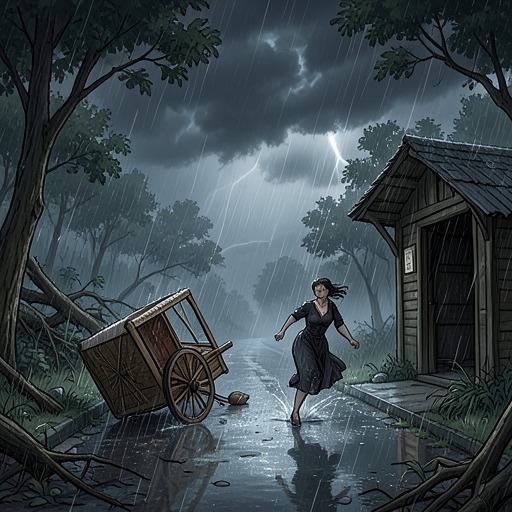
The immediate chain of events begins as Mandakini arrives in Thanjavur with Poonguzhali and Azhwarkkadiyaan. A storm has damaged Sendhan Amudhan’s home, and the trio has found Mandakini there while attending to its aftermath. Poonguzhali has persuaded her aunt to accompany them by explaining that Sundara Chozhar is gravely ill and longs to see her. The party reaches the fort as the Velakkara Regiment is entering. Azhwarkkadiyaan proposes using a secret passage to avoid the crowds, but Mandakini follows the people through the gate instead, departing from the route her companions intended to take.
How the Quarrel Begins
Mandakini’s unusual choice puts her among the crowd and attracts attention. Some people remark on her resemblance to Nandhini. Poonguzhali and Azhwarkkadiyaan try to shield her by pushing through the people in front of her; their efforts are misunderstood, and onlookers criticize Azhwarkkadiyaan for apparently harassing a woman. The Velakkara soldiers, alerted by the murmurs, turn back and surround Mandakini, separating her from the crowd. One approaches and asks who she is and whether anyone has troubled her. As usual, Mandakini offers no information.
The incident might have ended with that unanswered inquiry, but the crowd’s comments draw in another group. The scene is near Chinna Pazhuvettarayar’s palace, and some of his men arrive after hearing the commotion. They hear a contemptuous remark about the Pazhuvoor clan and demand to know who made it. A Velakkara warrior claims responsibility; the exchange shifts from accusations about one man’s conduct to mutual attacks on the pride and arrogance of the two groups. The resemblance that first made Mandakini the focus of attention has thus brought the rival soldiers into direct contact, but it is the quarrel over honor that supplies the immediate spark.
From Insult to Street Fighting
The argument escalates when someone accuses the Velakkara soldiers of having drowned the prince and blames men like them for the storms and cyclones afflicting the kingdom. A Pazhuvoor soldier reacts to the accusation by launching himself at the speaker. That attack acts as the signal for the two groups to fall upon each other. The narrative presents the brawl as a rapid change in the character of the gathering: people drawn together by curiosity are caught amid a clash whose participants now identify themselves by their political loyalties.
The cries from the crowd make those loyalties audible. One group supports the Pazhuvoor patrons; another declares loyalty to Sundara Chozhar. Others invoke the Kodumbalur Velaar and Thirukkovilur Malayaman. The shouted names do more than accompany the fight: they reveal how readily a local confrontation can gather the kingdom’s wider rivalries around it. The accusation concerning Arulmozhi Varman’s supposed death connects the street violence to public suspicion of the authorities, while the competing declarations of allegiance turn the surrounding crowd into an audience for those divisions.
Intervention and Aftermath
Chinna Pazhuvettarayar appears on horseback, and his arrival quiets the chaotic crowd. People scatter in every direction. The Velakkara Regiment moves on with what dignity it can recover, while Pazhuvoor soldiers gather around their commander to report their grievances. The scene ends not with a stated judgment or reconciliation, but with the street dispersing and the opposing groups carrying away their complaints. The immediate disorder subsides; the underlying conflict remains unresolved.
In that interruption, the episode’s personal danger emerges alongside its political significance. Once the crowd has scattered and the soldiers have rearranged themselves around their leaders, Poonguzhali and Azhwarkkadiyaan discover that Mandakini is missing. They search the nearby streets after Chinna Pazhuvettarayar and his men depart, but find no trace of her. The intended journey to Sundara Chozhar has therefore been overtaken by two consequences: open violence between armed factions and the disappearance of the person whose presence first drew attention. The clash is both a public expression of political distrust and the cover of confusion in which Mandakini vanishes.